How Bonus Questions Affect a Test Grade
What bonus questions do to a test's percentage and letter grade, why scores can pass 100%, and a grading table you can change to fit your test.
Posted by
 Paul Allen
Related reading
How to Grade With Half Points (With Examples)
How half-point scoring changes a test's percentage and letter grade, with worked examples and a grading table you can change to fit your test.
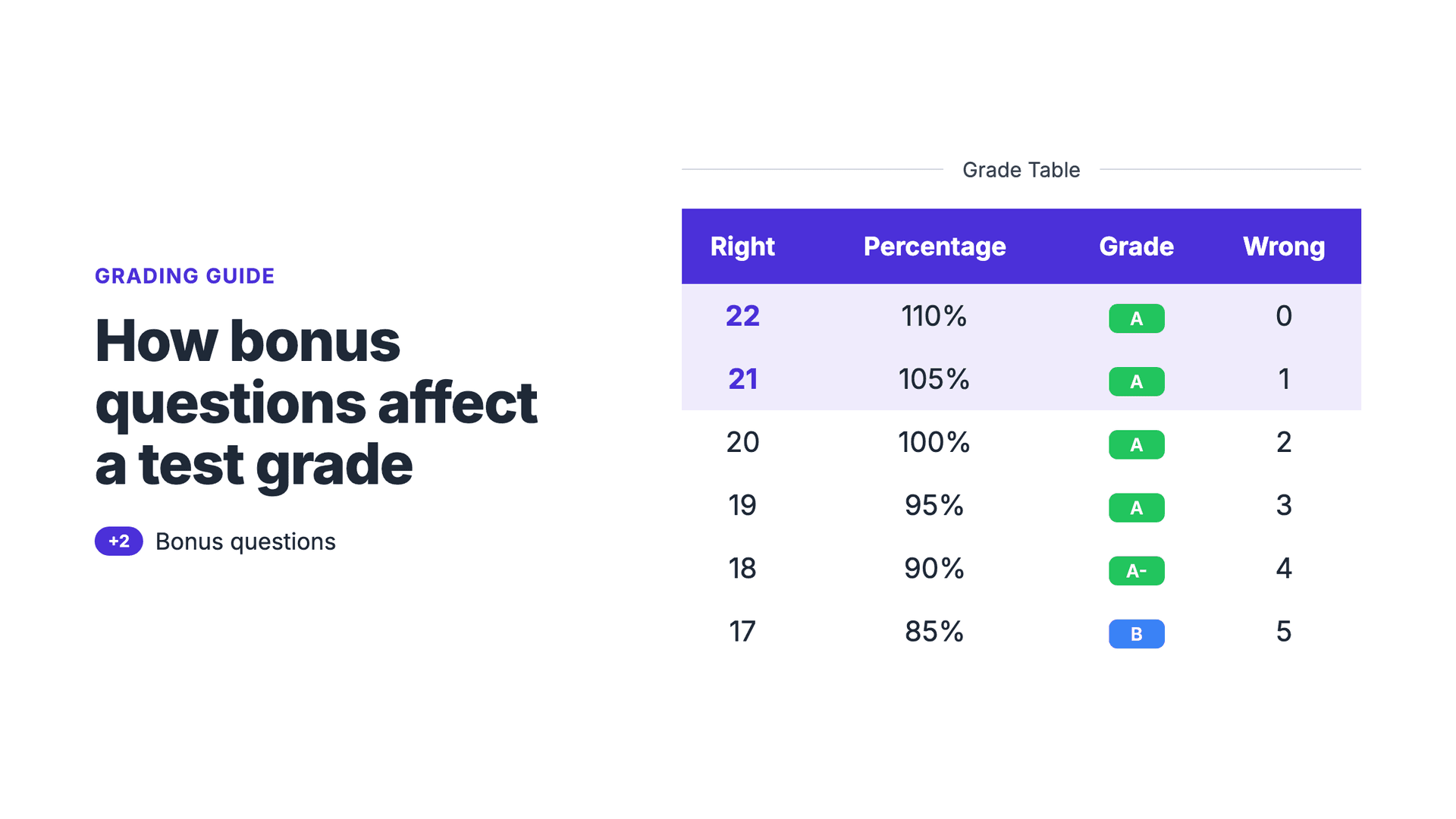
A bonus question is a question that can only help. Get it right and the score goes up. Get it wrong or skip it and nothing is lost. That makes bonus questions a popular way to reward a student who studied past the basics, or to give a student a chance to make up a point they missed elsewhere on the test.
What's less obvious is what a bonus question does to the arithmetic. It doesn't make the test longer in the way a regular question does, a perfect score can now go past 100%, and the number of questions a student got wrong no longer tells you their grade on its own. This guide works through those effects with the same grading table the GradeCalculate calculator uses, so every number below is one you can check.
How a bonus question changes the math
A test grade is the points a student earned divided by the points the test is worth. A bonus question adds to the first number and leaves the second one alone. The test is still scored out of its regular questions, and the bonus sits on top.
Take a 20-question test with 2 bonus questions. A student who gets 17 regular questions right and skips both bonus questions scores 17 out of 20, which is 85%, a B. That's exactly what 17 right earns on the same test without a bonus: 85%, a B. Adding bonus questions doesn't change what a regular question is worth.
Now say a classmate also gets 17 regular questions right but answers both bonus questions correctly. That's 19 points out of 20, or 95%, an A. The bonus made up for two of the three questions they missed.
| Right | Percentage | Grade |
|---|---|---|
| 22 | 110% | A |
| 21 | 105% | A |
| 20 | 100% | A |
| 19 | 95% | A |
| 18 | 90% | A- |
| 17 | 85% | B |
| 16 | 80% | B- |
| 15 | 75% | C |
| 14 | 70% | C- |
| 13 | 65% | D |
| 12 | 60% | D- |
| 11 | 55% | F |
| 10 | 50% | F |
| 9 | 45% | F |
| 8 | 40% | F |
| 7 | 35% | F |
| 6 | 30% | F |
| 5 | 25% | F |
| 4 | 20% | F |
| 3 | 15% | F |
| 2 | 10% | F |
| 1 | 5% | F |
| 0 | 0% | F |
Scores over 100%
Because the bonus sits on top of the test, a student who gets everything right scores more than 100%. On the 20-question test above, 21 points is 105% and a perfect 22 is 110%. On a short quiz the jump is bigger. With 10 questions and 1 bonus question, a perfect paper is 110%, since a single question is worth a tenth of the grade.
Every score at or above the A cutoff is still an A, so the letter doesn't change past that point. The percentage is what carries the extra credit, and it matters when test scores are averaged together. A 110% on one test pulls up the average of the others. Gradebooks differ on this. Some record a score above 100% as it is and others cap it, so check how yours handles it before you promise the class the bonus will carry over.
Count what's right, not what's wrong
On a regular test, counting wrong answers is a quick way to grade: one wrong out of 20 is 95%, whichever question it was. Bonus questions break that shortcut, because a missed bonus question costs nothing and a missed regular question does.
The calculator's Wrong column counts every question on the paper, bonus ones included. On the 20-question test with 2 bonus questions, "2 wrong" is the row for 20 right, which is 100%: a student who aced the regular questions and skipped both bonus questions.
The trap is counting only the regular questions a student missed. Say a student misses one regular question and leaves both bonus questions blank. They earned 19 points, which is 95%. But the "1 wrong" row is 21 points, which is 105%, because it assumes both bonus questions were answered and one of them was right. It's safer to add up the points each student earned and read that row instead.
Bonus questions or extra questions?
Some teachers add the bonus questions to the test total instead, so a 20-question test with 2 bonus questions is scored out of 22. That isn't a bonus any more: the extra questions count against a student who misses them, and every regular question is worth a little less.
The difference shows up quickly. Scored out of 22, the student with 17 right and no bonus gets 77% (a C+) instead of 85%. Their classmate with 19 gets 86% (a B) instead of 95%. Both choices are legitimate, but they're different tests, so pick one before you hand the paper out and tell the class which it is.
On a longer test the bonus questions move the grade by less. On a 25-question test with 3 bonus questions, a student who gets 21 regular questions right earns 84% (a B). All three bonus questions on top bring them to 24 points and 96% (an A).
How to set up bonus questions in the calculator
- Open the grade calculator and enter the number of regular questions on the test.
- Open Settings and turn on Bonus Points. It's free.
- Enter the number of bonus questions in the Bonus field and press Set.
- Find the row for the points each student earned, bonus included.
To compare with a test that has no bonus, the regular scales for a 20-question test and a 25-question test list every score on the default scale.
When bonus questions make sense
A bonus question works best when it asks for something a little beyond what the test covers: applying an idea to a new case, connecting two topics, or explaining why an answer is right. A student who studied the material well has a fair shot at it, and a student who didn't isn't punished for leaving it blank.
Keep the bonus small next to the test. One or two bonus questions on a 20-question test lets a student recover a missed question or two. Five bonus questions on a 10-question quiz means a student could miss half the quiz, answer every bonus question, and still score 100%, which makes the grade say less about what they know.
Decide the rules before the test, not after. Will bonus points carry over if they push a score past 100%? Can they make up for a question left blank, or only one answered wrong? Write it down and apply it to every paper the same way, so a grade is easy to explain when a student or parent asks. If your school or department has a policy on extra credit, that policy comes first.
Finally, a bonus question should still be about the subject. Points for bringing in a signed form or a box of tissues might be useful in the classroom, but they mix something else into a grade that's meant to measure what a student learned.
The short version
A bonus question adds to a student's points without adding to the test's total, so it can only raise a grade and a perfect paper goes past 100%. Count the points a student earned rather than the questions they missed, and decide up front whether the extra questions are a true bonus or part of the test. To check a score, try the table above or open the grade calculator and turn on Bonus Points.
