How to Grade With Half Points (With Examples)
How half-point scoring changes a test's percentage and letter grade, with worked examples and a grading table you can change to fit your test.
Posted by
 Paul Allen
Related reading
How Bonus Questions Affect a Test Grade
What bonus questions do to a test's percentage and letter grade, why scores can pass 100%, and a grading table you can change to fit your test.
Some answers aren't all right or all wrong. A student sets up a two-step problem correctly and then slips on the arithmetic. A short answer gets the main idea but misses a key detail. Marking either one wrong undersells what the student knew, and marking it right oversells it. Half points split the difference: the question is worth one point, and the student earns half of it.
The tricky part is the math afterwards. Once half points are in play, a score like 7.5 out of 10 or 17.5 out of 20 has to become a percentage and a letter grade, and rounding decides which side of a cutoff it lands on. This guide works through those numbers with the same grading table the GradeCalculate calculator uses, so you can check any score at a glance.
What half points do to a grade
With half points, a question worth one point can earn half a point. The score still counts out of the number of questions on the test, so a half point moves the percentage by half as much as a whole question does.
Take a 10-question quiz. A student who gets 7 questions right and earns half credit on an eighth scores 7.5 out of 10, which is 75%, a C on the default scale. Without half points, you'd have to mark that question all right or all wrong, and the student would get either 70% (a C-) or 80% (a B-).
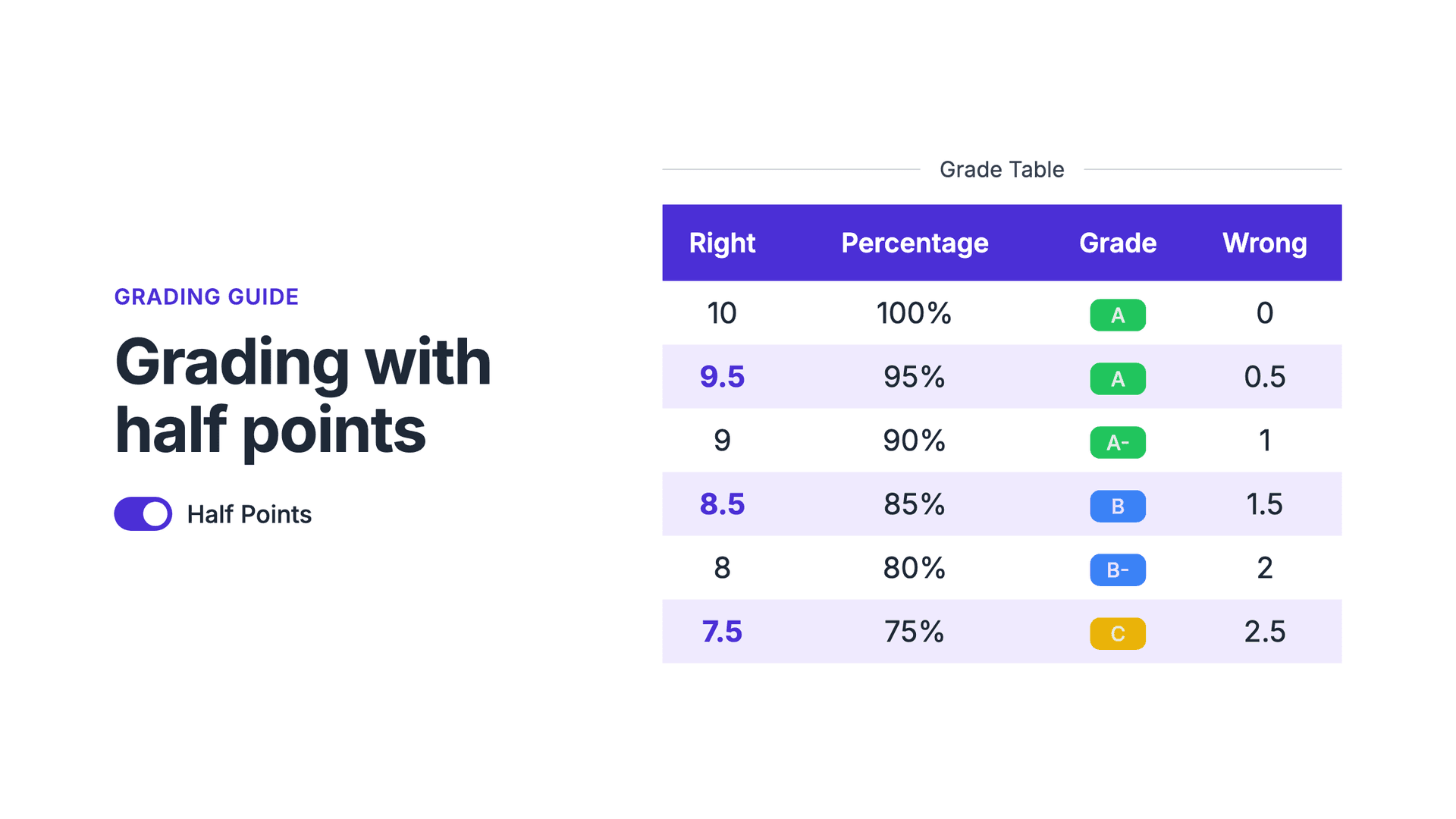
The arithmetic gets harder when the question count isn't a round number. On a 17-question test, 13.5 right is 79%, a C+. Few people work that out in their head halfway through a stack of papers. A grading table lists every possible score, half points included, with its percentage and letter, so you read the answer off instead of dividing each time.
The Wrong column counts in half points too. On a 10-question quiz, 2.5 wrong is the same score as 7.5 right, so you can grade by counting either one.
| Right | Percentage | Grade |
|---|---|---|
| 10 | 100% | A |
| 9.5 | 95% | A |
| 9 | 90% | A- |
| 8.5 | 85% | B |
| 8 | 80% | B- |
| 7.5 | 75% | C |
| 7 | 70% | C- |
| 6.5 | 65% | D |
| 6 | 60% | D- |
| 5.5 | 55% | F |
| 5 | 50% | F |
| 4.5 | 45% | F |
| 4 | 40% | F |
| 3.5 | 35% | F |
| 3 | 30% | F |
| 2.5 | 25% | F |
| 2 | 20% | F |
| 1.5 | 15% | F |
| 1 | 10% | F |
| 0.5 | 5% | F |
| 0 | 0% | F |
Rounding: when half a point changes the letter
On a longer test, a half point can land between two whole percentages. The calculator rounds to the nearest whole percent, and a half rounds up.
On a 20-question test, 17 right is 85%, a B. Add half a point and 17.5 out of 20 is 87.5%, which rounds to 88%: a B+. One more half point, 18 out of 20, is 90%, an A-.
Half points double the number of possible scores, so more of them land right next to a cutoff than on a whole-point test. If your school rounds differently, or doesn't round at all, check the scores that sit right on a cutoff by hand.
How to set up half points in the calculator
- Open the grade calculator and enter the number of questions on the test.
- Open Settings and turn on Half Points. It's free.
- Read each student's score off the table, including the .5 rows.
To compare with whole-point scoring, the full-point scales for a 10-question test and a 20-question test list every score on the default scale.
When half credit makes sense
Half points work best on questions with more than one step, where a student can get part of the way there. A math problem with a correct setup and a wrong final answer is the classic case, but so is a short answer that names the right idea without explaining it, or a definition that's close but incomplete.
They make less sense on questions with only one possible answer. Multiple-choice and true-or-false questions are right or wrong by design, and giving half credit for a near miss there mostly rewards guessing.
Whatever you decide, decide it before you start grading. A short rule works well, for example "half credit for a correct method with one calculation error". Write it down and apply it the same way on every paper. A consistent rule is fairer to the class, quicker to grade with, and much easier to explain when a student or parent asks why one answer got half credit and another didn't. If your school or department has a policy on partial credit, follow that policy first.
Keep half credit for what the student understood, not for effort or neatness. Those can matter, but folding them into the score makes it harder to tell what a grade actually measures.
Finally, if a question has several parts, a half point may be too blunt. When three of four parts are right, half credit undersells the answer. You could split it into separate questions, or use quarter points (a Pro setting in the calculator), which let each question earn 0.25, 0.5 or 0.75.
The short version
Half points let a score reflect partial understanding without changing how the test is scored: the percentage still divides by the number of questions. Set a clear rule for when half credit applies, use it on every paper, and double-check any score that sits right on a cutoff, because rounding can move it up a letter. To check a score, try the table above or open the grade calculator and turn on Half Points.
